Is All the Hate for Data Centers Warranted?
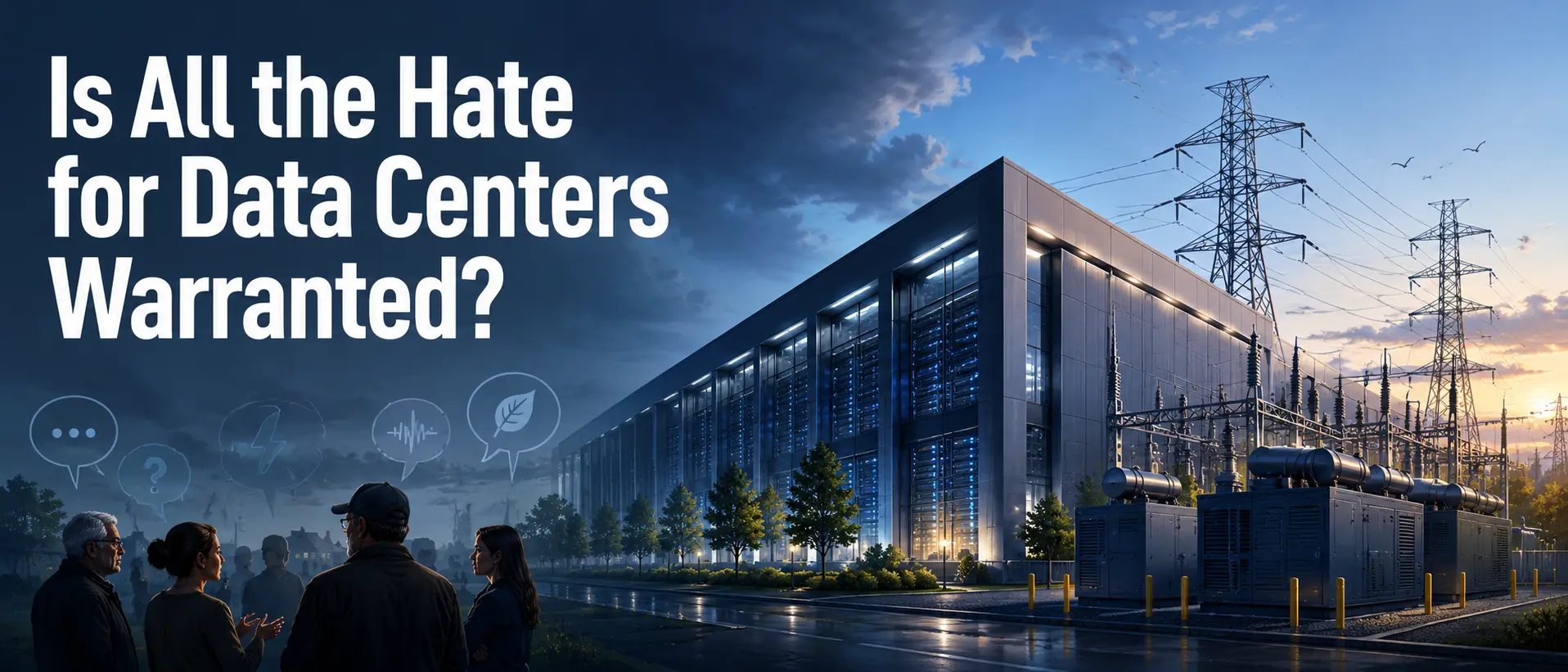
It seems like every few years, there is a new controversy that pops up in the world. This is worsened by conspiracy theorists who spread misinformation and people on social media unwittingly re-sharing this information. In 2020 it was masks, the COVID vaccine, and the unreasonable hoarding of toilet paper, but it seems the latest controversy is around data centers. I will leave it up to you to decide if data centers should be welcomed in your local community by going through the facts and lies about Data Centers. Sit back and grab a coffee; this will be a long one.
First, I want to make one thing clear: there is really no difference between the terms "data center" and "AI data centers" - A data center is nothing more than a building designed to house servers. Any data center can house specialized AI hardware. For some reason, people seem to want to demonize "AI data centers" but are fine with regular data centers - they are pretty much the same thing.
Data Centers Consume a Lot of Water: Myth
There is a persuasive campaign out there that Data Centers consume a massive amount of water to operate; I am honestly not sure where this started, but it is factually untrue and in many ways violates the laws of physics, as water cannot be "destroyed" so even if data centers did consume water, it would be released as steam back into the environment.
Most Data Centers run on a closed-loop system, which recirculates the same water through their system for most of their servicing life, only requiring a refill if the cooling system needs to be drained for maintenance or repairs. I would go on to say that the things in modern data Data Centers that use the most amount of water are the sinks and toilets in the employee restrooms.
In some cases, you do see data centers with a drainage system that pours water into the sewage system; this is often because data centers, especially in humid areas, tend to run dehumidifiers, which pull water out of the air and put it into the local water systems. It should not come as a shock, but computers don't really like moisture.
I own and run an AI supercomputer at home, a small scaled-down version of the type of hardware that you would see in a data center, the Nvidia DGX Spark, and I have yet to find a water inlet to connect it to the water supply.
On a related sidenote, here are a few things that consume significantly more water than a data center Golf Courses A Typical High School A Shopping Mall A hotel/casino A prison
Data Centers Bring Numerous Jobs: Partially True but Misleading
Supporters of Data Centers often make the claim that data centers will bring many jobs into a community, and this is very misleading. Data Centers are known for running lean on staffing. They will have a helpdesk staffed with a few engineers, but generally speaking most data centers can be run with a few dozen people, not hundreds. In my personal experience, the largest departments I see in data centers are for their security, as they are often heavily fortified. I have seen data centers where you can feed the whole staff with a single box of doughnuts.
The other reality is that many large-scale data centers tend to outsource their first-level technical support to a call center, often overseas. These outsourced engineers will open the tickets, triage the issue remotely, and only page the on-site staff if there is an issue that requires someone to physically manipulate the servers. Thanks to remote KVMs, IPMI, and Remote Power Management, you would be shocked how much you can do with a server remotely.
Now what is true is that the construction of Data Centers can bring a lot of temporary construction jobs to an area, but these jobs will not stick around in the long term. This has a knock-on effect as these temporary employees can either be sourced locally or relocated from other areas of the country to help in construction. This does bring in a short-lived economic boost to the local community, especially for restaurants, hotels, and other businesses that cater to locals. Unfortunately, this boost to the local economy is short-lived and will die again after the construction is done. This again has a knock-on effect on businesses that increased staffing and spending, expecting the boost to be long-lasting, resulting in layoffs or businesses going under without a sustainable business model.
Data Centers Produce a Lot of Noise: Fact
This is mostly true, true enough that I will gladly label it a fact. Inside a large data center, the noise from the server fans alone can be loud enough to necessitate the need for ear protection. The outside is far less noisy but not completely silent. Nearby residents of a data center may not care much about the inside noise and may be able to tolerate the sound from the outside; however, the big driver of noise from a data center is from the generators.
A proper data center will have multiple power sources, often from two or more diverse power grids as well as a few industrial emergency generators that can run the data center for days in the event of a large-scale power outage. These massive school-bus-sized generators can produce a massive amount of noise. These generators do not sit idle 24/7; when there are no power outages, the data center is required to perform periodically scheduled tests of the generators to ensure they are in proper working order.
Of course I am not going to bring up the noise from trucks, construction, and other things that go into the ongoing running of the data center.
Data Centers Consume A Lot of Power: Fact
Opponents of Data Centers will quickly point out the fact that Data Centers put a real strain on the electric grid; this is undoubtedly a fact. Several states have been caught with their pants down when it comes to their stats capacity to supply power to match the demand from Data Centers. California reporting that up to 25% of the entire state's energy consumption is tied to a Data Center. California is a state where rolling blackouts are not unheard of, which could put a California Utility Company in a position to choose between diverting power from residents to a Data Center or vice versa. The governor of Texas has blessed the creation of the world's largest data center and, up until recently, was pushing for tech companies to build more Data Centers in Texas - which is concerning as the state of Texas can sometimes barely handle the existing demand from the current users, as demonstrated in the 2021 Texas (Nearly) Statewide Blackout on one of the coldest days of winter. There are countless other examples In addition to the examples above, many cities and counties that want to encourage the building of Data Centers have entered into sweetheart deals with the Data Center to essentially gift them the land and even subsidize the power and construction costs, which is ludicrous, as any other private company would be expected to pay for that themselves.
Unfortunately in the current political administration, the idiotic shift away from renewable energy sources will make this problem even worse. While it is true that storing unused energy from Solar Power is often impractical, it can be fed into a Data Center at the hottest times of the day to help with the cooling and energy consumption - during the times of the day when the solar panels are getting the most amount of sun.
I am trying my best not to inject my personal opinion on this post, but this is my site, and I can do what I want. If a private business wants to build a Data Center, they should foot the bill for any construction at the current market cost. They should be required to purchase the land at the fair market price and not be given any tax breaks or sweetheart deals that the local town diner would not be able to get. If the local electrical infrastructure is not up to handling a Data Center, the Data Center should be the one responsible for all the costs to build it out. Remember, a sweetheart deal, selling land below market value and giving tax breaks, is just a nice way of passing the cost onto the local taxpayers.
Land Theft via Eminent Domain to Seize Private Property: True
This one honestly upsets me, as there are countless examples of cities, counties, power companies, and even data centers abusing eminent domain to seize private property. This includes generational family farms, vacant lots, homes, and other plots of land, often forcing the former owners of the private property to accept lowball offers as they are being moved out of their homes with no choice to decline or negotiate.
I firmly believe that when someone buys a piece of property, it is theirs to do with as they wish - under no circumstances should anyone be able to seize property to hand it over to a private company, often under the guise of community redevelopment projects or economic development projects. This is blatant abuse of our legal systems, and unfortunately courts have often sided with the data center instead of the property owner. This is often because the legal costs to fight a frivolous eminent domain case fall on the homeowner, not the deep-pocketed data center.
Just like how I hinted earlier in this post, Data Centers should get the same treatment as any other local business. A local town diner should not be able to work with the local city council to seize my driveway to build out their parking lot, so why should a data center be able to do the same? Furthermore, if someone does not want to sell their property, then they should never be forced to sell it.
Environmental Impact
It goes without saying, any sort of construction will have an impact on the local environment, but ultimately the impact does vary based on the location. Obviously, if a former shopping mall is re-purposed into a Data Center (and I would absolutely support that idea), it would have far less of an impact than leveling 30 acres of wooded forests in the Adirondacks. As with any project of this sort, an environmental study needs to be conducted to determine its impact on the area. Honestly, I would not mind seeing abandoned nuclear missile silos being used for data centers.
Ignoring the false information around the water usage, the strain on the electric grid and other local infrastructure is true and may require additional construction projects to improve and modernize things, which will also have an impact on the environment.
Finally, we need to look at the power sources being used to power the data centers; if the power companies use fossil fuels or coal to generate power, the impact will be significantly higher than nuclear/solar/wind or hydroelectric plants. There is a huge chance that the power plant will have to be built out, and adding additional coal- or fossil fuel-based power plants will have a massive impact on the environment.
We Need More Datacenters: Fact
In the 1950s the Space Race kicked off, which put two global superpowers against each other to be the first to launch a human into space. The Space Race was seen as one of humanity's greatest accomplishments. I would argue that the AI race is even more consequential. Whichever country manages to edge out the other could become the next global superpower - so yes we do need more compute resources; thus, there is a genuine need for more data centers.
The key is to build data centers in a responsible and ethical way, but before we do build more data centers, it is critical to improve our nation's failing infrastructure. All the power grids in the United States need to be modernized and enhanced to add significantly more capacity. We need to bolster our current power plants with more renewable energy options and replace ancient power plants with more modern power plants that can keep up with the load.
We also must stop subsidizing private data centers and let them pay for resources in the same way a normal local business does. The revenue a power company gets from these data centers should in part go to reinforcing the power grid.
Finally, we have to come up with more innovative and creative ways to distribute compute resources, such as repurposing abandoned buildings or decommissioned missile silos.
Why Not Build All Data Centers In A Central Location?
Some people have floated the idea of putting a majority of new data centers in a centralized location. Some have proposed the salt flats of Utah, others have proposed the western areas of Texas, and yet others have proposed a state like Wyoming or Kansas. These proposals also mention building out a power infrastructure solely dedicated to the data centers in order to eliminate the strain on the public grid.
While this does seem like a good idea, this introduces a massive problem that I would consider to be an issue of national security as a single attack from a hostile foreign adversary. Natural disasters also become a problem, as a single hurricane, tornado, earthquake, Godzilla attack, or winter storm could severely cripple most of the nation's compute resources. It is critical that data centers be built in as many diverse areas as possible to add redundancy to our nation's compute resources.